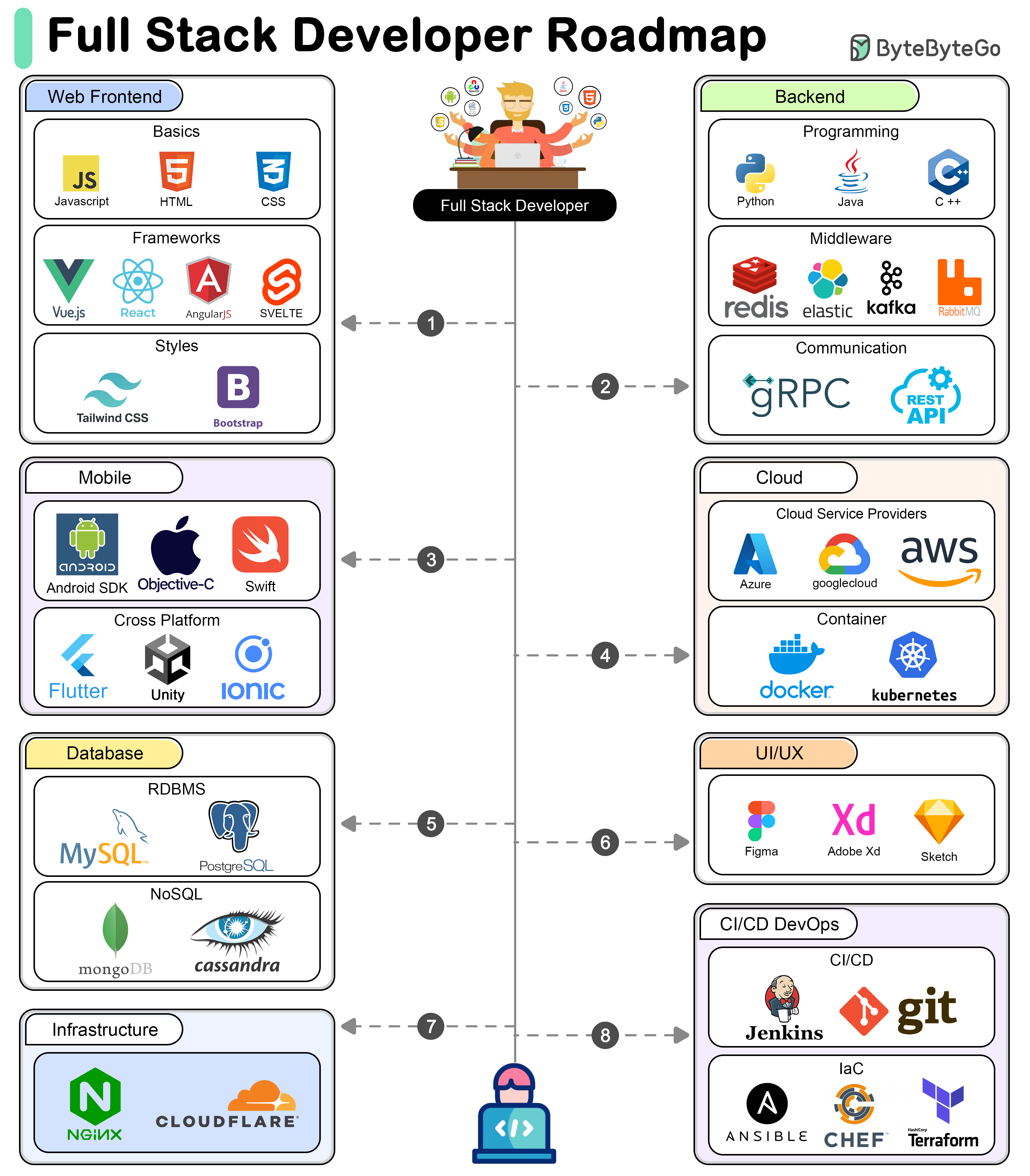
Introduction
- The demand for .NET Full Stack Developers is growing rapidly across India and globally. Companies are actively hiring developers who can handle both backend logic and frontend UI — making Full Stack one of the most valuable skill sets in 2025.
- In this blog, we'll cover the complete roadmap — from basics to deployment.
What is a .NET Full Stack Developer?
A .NET Full Stack Developer is someone who can build complete web applications using Microsoft's .NET ecosystem. This includes:
- Backend: ASP.NET Core, C#, REST APIs
- Database: SQL Server, Dapper / Entity Framework
- Frontend: HTML, CSS, JavaScript, Bootstrap
- DevOps: Git, Azure, CI/CD
Step 1 — Master C# Fundamentals
C# is the heart of the .NET ecosystem. Before jumping into frameworks, make sure you understand:
- OOP concepts (Classes, Inheritance, Interfaces)
- LINQ and Lambda Expressions
- Async / Await (very important!)
- Generics and Collections
- Exception Handling
Tip: Practice daily on platforms like LeetCode or HackerRank using C#.
Step 2 — Learn ASP.NET Core MVC
- MVC Architecture (Model, View, Controller)
- Routing and Middleware
- Dependency Injection
- Model Binding and Validation
- View Components and Partial Views
- Tag Helpers and Razor Syntax
Step 3 — Database with SQL Server + Dapper
Every backend developer must be strong in databases. Focus on:
- Writing complex SQL queries (JOINs, CTEs, Subqueries)
- Stored Procedures and Functions
- Indexing and Query Optimization
- Dapper ORM — lightweight and fast
- Database design and normalization
Why Dapper over Entity Framework? Dapper gives full control over SQL, is much faster, and is perfect for complex enterprise queries.
---
Step 4 — Build REST APIs
REST APIs are the backbone of modern web applications. Learn:
- Creating Web API controllers in ASP.NET Core
- HTTP Methods (GET, POST, PUT, DELETE)
- JWT Authentication and Authorization
- Swagger / OpenAPI documentation
- API versioning and error handling
---
Step 5 — Frontend Basics
As a Full Stack Developer, you need to know:
- HTML5 and CSS3
- JavaScript (ES6+)
- Bootstrap 5 for responsive design
- Basic jQuery or Alpine.js
- Fetch API / Axios for API calls
Bonus: Learning basic React or Vue.js makes you even more valuable.
Step 6 — Clean Architecture
Once you know the basics, level up with:
- Clean Architecture (Domain, Application, Infrastructure layers)
- Repository Pattern
- CQRS with MediatR
- Dependency Injection best practices
This is what separates junior developers from senior developers.
Step 7 — DevOps and Deployment
Don't stop at just coding — learn to deploy:
- Git and GitHub (version control is a must)
- Azure App Service for .NET deployment
- Docker basics
- CI/CD pipelines with GitHub Actions or Azure DevOps
---
Real Projects to Build
The best way to learn is by building real projects:
1. Student Management System — CRUD with SQL Server + Dapper
2. E-Commerce Platform — Cart, Orders, Payment Gateway
3. Hospital Management System — Appointments, OPD, Billing
4. REST API with JWT Auth — Full CRUD + Swagger docs
5. Portfolio Website — Your own personal brand (just like this one!)
Salary Expectations in India (2025)
- Fresher (0–1 yr): ₹3–5 LPA
- Junior (1–3 yrs): ₹5–10 LPA
- Mid-Level (3–5 yrs): ₹10–18 LPA
- Senior (5+ yrs): ₹18–35 LPA
Conclusion
Becoming a .NET Full Stack Developer is one of the best career decisions you can make in 2025. The ecosystem is mature, the jobs are high-paying, and the community is strong.
Start with C#, build projects, and keep learning. The roadmap is clear — now it's your turn to walk it!
Happy Coding! 🚀